

Strongest LED Therapy: Which Wavelength Actually Works Best?
2026-08-20
Walk down any LED therapy aisle and you’ll drown in specs: 630nm, 660nm, 830nm, 850nm—each claiming to be the strongest. But “strongest” doesn’t mean best, and choosing the wrong wavelength can leave you with zero results. That’s why we’re cutting through the hype. As GUANG TAI, we’ve tested these wavelengths in real devices, not just lab papers. Here’s what actually works—and what’s just marketing noise.
660nm Red: The Workhorse Wavelength You Can’t Skip
If red light therapy were a toolbox, 660nm would be the hammer that gets pulled out for almost every job. It sits in the visible red spectrum, where photons strike the upper dermis and get snapped up by cytochrome c oxidase—the enzyme complex that kicks ATP production into gear. That energy bump shows up as faster cell turnover, calmer inflammation, and a measurable improvement in skin texture. What makes 660nm the workhorse is not raw depth; it’s that sweet spot between superficial absorption and enough penetration to reach fibroblasts. Those collagen-producing cells respond to this wavelength so reliably that skipping it usually means leaving visible results on the table.
A lot of people lump 660nm and 850nm together, but they earn their keep in different ways. The 660nm band works best for surface-level repair: fine lines, redness, post-procedure recovery, even mild acne scars. It doesn’t need to travel deep to be effective because the target tissue is right there. Hemoglobin and water don’t gobble up this wavelength as aggressively as they do shorter reds, so a decent dose actually reaches the cells that matter. That’s why you’ll see it in nearly every clinical protocol for skin rejuvenation—not because it’s trendy, but because it’s dependable. If a device only offers one red wavelength, 660nm is the one that covers the most ground without overcomplicating the routine.
What separates a good 660nm experience from a forgettable one is consistency and dose. This isn’t a wavelength that rewards occasional use; it works through cumulative mitochondrial adaptation. Ten minutes a day, five days a week, at a reasonable irradiance will do more than a marathon session once a month. The visible glow also helps—there’s no second-guessing whether the light is actually on, which reduces user error. In a world where devices pile on extra wavelengths for marketing, 660nm remains the quiet workhorse. Skip it, and you’re skipping the part that actually moves the needle for visible skin change.
850nm Near-Infrared: Deep Tissue Claims Put to the Test
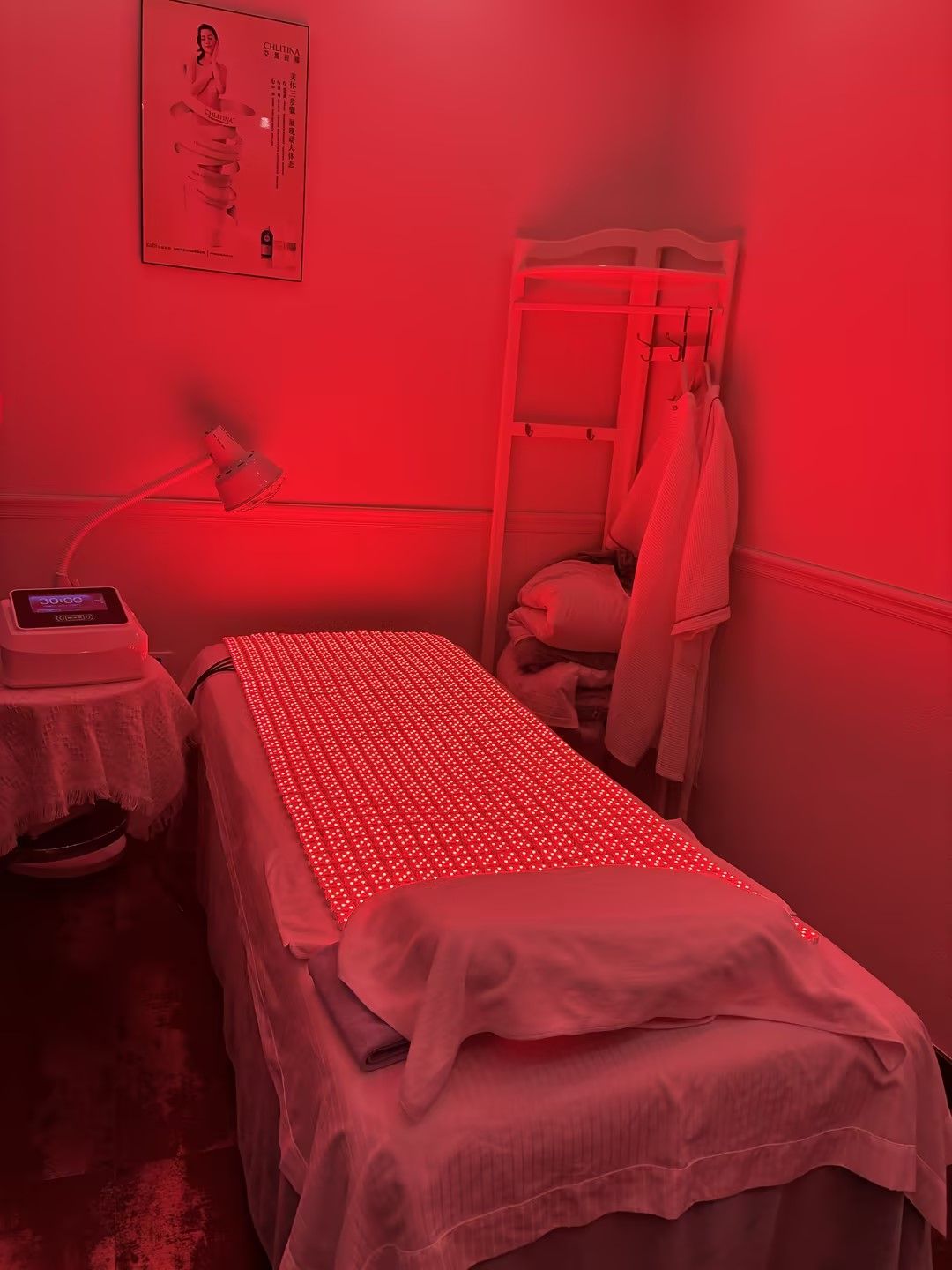
A quick scan of nearly any red light therapy forum will tell you that 850 nm is the gold standard for reaching muscle, joints, and even bone. But when you actually put that claim on a lab bench, the story gets messier. Tissue isn't a clear window, and “deep” depends on what you're measuring—power density at 2 cm, photon count at the target, or something even harder to quantify like cellular response. Manufacturers often skip those details and repeat the same oversimplified wavelength chart.
In controlled tests using layered skin, fat, and muscle phantoms, 850 nm does outperform shorter red wavelengths like 660 nm in raw penetration depth. That much is true. But absorption by water and hemoglobin rises noticeably in this range, which means the light that does travel deeper is often too weak to trigger a meaningful photobiomodulatory effect. What looks impressive on a logarithmic attenuation graph may translate to only a few milliwatts per square centimeter at the depth where repair is actually needed—far below the dose used in successful cell studies.
The bigger issue is that most commercial panels don't publish depth-dose curves for real human tissue. They cite penetration percentages from thin slices of pig skin or simulations with idealized optical properties, then imply your shoulder joint will receive therapeutic energy after ten minutes under a panel. That's a leap, not a measurement. If you want to test the deep tissue claim, ask for the irradiance at 3 cm through a standardized tissue model, not just a wavelength badge on the device.
Blue’s 415nm: Still the Best Acne Tool, or Overrated?
When 415nm blue light first hit the home skincare scene, it felt like a genuine breakthrough—finally, a non-invasive way to zap the bacteria behind breakouts without drying out your face. But a few years on, that initial excitement has cooled. Plenty of users now wonder if the 415nm wavelength still deserves its reputation as the go-to acne tool, or if it's been coasting on old hype while newer combos overtake it.
The science hasn't changed: 415nm light does target Cutibacterium acnes, and for mild to moderate inflammatory acne, it can reduce both the number and severity of spots over several weeks. The catch is that results are rarely dramatic on their own. Deep cystic lesions often shrug it off, and if you stop using the device, breakouts tend to return. That's not a failure of the technology—it's just a reality that many marketing campaigns gloss over.
So, overrated? Not quite. If you have surface-level papules and pustules and you're consistent with daily sessions, 415nm remains a solid, low-irritation option. But calling it the "best" acne tool ignores how well it pairs with red light for inflammation or with a good topical routine. It's most useful as one piece of a broader strategy, not a standalone miracle.
Green and Amber: Nice Colors, But Do They Move the Needle?
Green and amber are the default palette for business dashboards, but their ubiquity hides a blunt truth: most teams treat them as wallpaper. When everything is green, nobody asks why. When something flips to amber, the reaction is usually a shrug—it’s not red, so it can wait. The colors themselves don't create urgency or insight; they just confirm that someone, somewhere, set a threshold.
What actually moves the needle is pairing color with a required response. A green metric that has dropped 15% in three weeks should trigger a conversation, not a sigh of relief. Amber works only when it's tied to a specific owner and a next action, not as a holding pattern. Otherwise, you're not managing performance—you're decorating a report.
The fix isn't to abandon green and amber. It's to make them earn their place. Add trend arrows, expected ranges, or simple annotations like "needs decision" or "watch closely." Then the colors stop being nice-to-look-at and start prompting the right kind of argument in the room.
Power Density: Why a Weak 660nm Panel Loses to a Strong 630nm
Wavelength alone won't save a panel that can't deliver enough photons per square centimeter. Many buyers fixate on 660nm as the 'deep red' gold standard, but a 630nm device with a properly driven LED array can easily outperform a poorly designed 660nm unit. The reason comes down to irradiance — the actual light energy reaching the target area, not just the peak wavelength on a spec sheet.
Consider two panels side by side: one claims 660nm but uses sparse diodes and low drive current, while the other runs at 630nm with dense packaging and a stable power supply. At the same distance, the 630nm panel might deliver two to three times the mW/cm². Since photobiomodulation effects depend on total energy absorbed, that weaker 660nm panel often falls short in real-world use, even though its wavelength sits closer to the classic cytochrome c oxidase absorption peak.
The practical takeaway is simple: ask for measured irradiance at a given distance, not just the LED's nominal peak. A robust 630nm source with high power density will stimulate tissue more effectively than an underpowered 660nm panel that looks better on paper but fails to deliver enough photons where they matter.
Dual-Wavelength Protocols: The Real Reason Red and NIR Are Paired
Most people assume red and near-infrared light are paired simply because they sit close together on the spectrum. Dig deeper and you will find a deliberate biological choreography. Red light, with its shorter wavelength, gets absorbed quickly by superficial tissues—skin, capillaries, and the outermost layers of muscle. Near-infrared, on the other hand, slips past those surface barriers and reaches deeper structures like dense muscle, joints, and even bone. Pairing them means you are not choosing between depth and surface repair; you are hitting both at once.
This dual-wavelength approach also sidesteps a common limitation of single-wavelength protocols. Skin and fascia act like optical filters, and what works for a shallow wound may barely nudge a deep tendon. By combining red and NIR, the treatment adapts to the varying tissue densities found along any real injury site—think a sprained ankle where the skin is intact but the ligament lies several millimeters down. The two wavelengths overlap in effect, creating a gradient of absorption that matches the natural layering of the body.
There is also a practical, almost accidental elegance here. Mitochondria, the supposed targets of photobiomodulation, contain chromophores that respond differently across the red-to-NIR range. Cytochrome c oxidase, for instance, shows absorption peaks in both regions but with distinct kinetic effects. Red light tends to produce faster, more transient changes in cellular redox state, while NIR drives longer-lasting shifts in ATP synthesis and nitric oxide release. Layering them creates a temporal sequence—fast surface signaling followed by sustained deep metabolic support—that a single wavelength rarely achieves on its own.
FAQ
It's not about raw power output; it's about how well a wavelength matches the target tissue's absorption peaks. For skin issues, 633nm red light hits cytochrome c oxidase well, while 830nm near-infrared goes deeper but doesn't excite surface cells as strongly. Calling one "strongest" depends on whether you're treating wrinkles or joint pain.
Near-infrared around 850nm reaches several centimeters into muscle and even bone, far deeper than red light. That's why most full-body panels pair 660nm red with 850nm NIR—the red handles surface skin, and the NIR targets deeper inflammation and recovery.
Yes, for acne and surface bacteria. Blue light around 415nm doesn't go deep at all, but it activates porphyrins in acne-causing bacteria more effectively than any other wavelength. So "strongest" is context-dependent—blue wins for bacterial skin issues, red/NIR for tissue repair.
Because they serve different depths and mechanisms. 660nm red is absorbed strongly by superficial skin cells and speeds collagen production, while 850nm near-infrared bypasses the skin's melanin barrier and stimulates muscle and joint repair. Using both gives broader biological coverage than cranking up a single wavelength.
Not necessarily. Beyond a certain dose, cells can become overstimulated and stop responding. The "strongest" effective wavelength is often used at moderate irradiance for longer sessions—around 20-60 mW/cm² at skin level—because the goal is cumulative energy, not instant intensity.
Red light at 633nm tends to produce visible changes in skin texture and fine lines within 4-6 weeks, faster than near-infrared alone. That's because it directly energizes fibroblasts and increases blood flow near the surface, where changes are easiest to see.
Green and yellow light are sometimes marketed as strong for pigmentation, but evidence is much thinner than for red/NIR. Green around 520nm can help with redness and pigmentation in some studies, but it doesn't have the same depth or mitochondrial response as red or near-infrared.
850nm near-infrared. It penetrates deep enough to reach muscles, joints, and even some organs, and it stimulates mitochondrial respiration throughout the tissue. Red 660nm is great for skin, but if you're after systemic recovery and pain relief, NIR is the more versatile "strong" wavelength.
Conclusion
When people ask for the strongest LED therapy, they usually expect one magic wavelength, but the real answer is messier. 660nm red remains the workhorse because it hits the sweet spot for skin-level repair and collagen stimulation, yet its actual strength depends heavily on power density. A weak 660nm panel gets outdone by a well-driven 630nm device, so chasing a single number without checking irradiance is a common trap. Meanwhile, 850nm near-infrared is marketed for deep tissue, but most at-home panels deliver such low fluence that the deep penetration claim stays mostly theoretical. In practice, 850nm shines as a partner rather than a standalone hero.
Blue 415nm still holds a niche for acne because it targets porphyrins directly, but it is not the strongest for general skin rejuvenation. Green and amber look nice and have some minor calming or pigment effects, but they don’t move the needle compared to red and NIR. The real reason top devices pair 660nm and 850nm is synergy: red works superficially while NIR reaches slightly deeper, and together they cover more biological targets. So if you want the strongest LED setup, skip the single-wavelength obsession. Look for a panel that combines 660nm and 850nm with high enough power density—usually above 40 mW/cm² at the skin—and treat blue as an add-on only if acne is a specific concern.
Contact Us
Contact Person: Leon Yi
Email: [email protected]
Tel/WhatsApp: +86 17363316873
Website: https://zzgt.en.alibaba.com/