

Rapid Transfer Port Solutions: Revolutionizing Containment and Efficiency in Cleanroom Operations
2026-11-02
Think a rapid transfer port is just a door? Think again. The latest RTP systems are cutting contamination risk and cycle times in ways older cleanroom setups can't match. This post looks at the engineering driving that leap—and how AVM is helping teams capture the gains.
Inside the Mechanics of Rapid Transfer Ports: Sealed, Secure, and Swappable
Rapid transfer ports solve a stubborn cleanroom problem: how to move materials in and out without breaking the sterile barrier. The core mechanism relies on two interlocking flanges—one mounted on the isolator or cleanroom wall, the other on a portable container. When the container docks, a mechanical interlock ensures both doors cannot open at once. This prevents any direct opening to the outside environment, maintaining a sealed condition throughout the transfer.
Security comes from a bayonet or alpha-beta port design. The alpha port stays fixed, while the beta assembly carries the container. Twisting the beta unit into the alpha locks the two faces together, and only then can the double doors be swung inward as a single unit. The seal is made by a compressed gasket around the mating surfaces, often silicone or EPDM, which withstands repeated sterilization cycles. This creates a leak-tight path that keeps contaminants out while allowing a rapid swap of canisters.
The "swappable" aspect lies in the modular design. Operators can dock a new pre-sterilized container in seconds, remove the sealed transfer, and repeat the process without cleaning the entire transfer chamber. Since the transfer port itself never opens to ambient air, batch integrity is preserved. This makes RTPs a practical choice for aseptic filling lines, pharmaceutical compounding, and any process where sterile transfer must be fast, reliable, and fully contained.
Why Sterile Liquid and Powder Transfers Depend on Double-Door Isolation
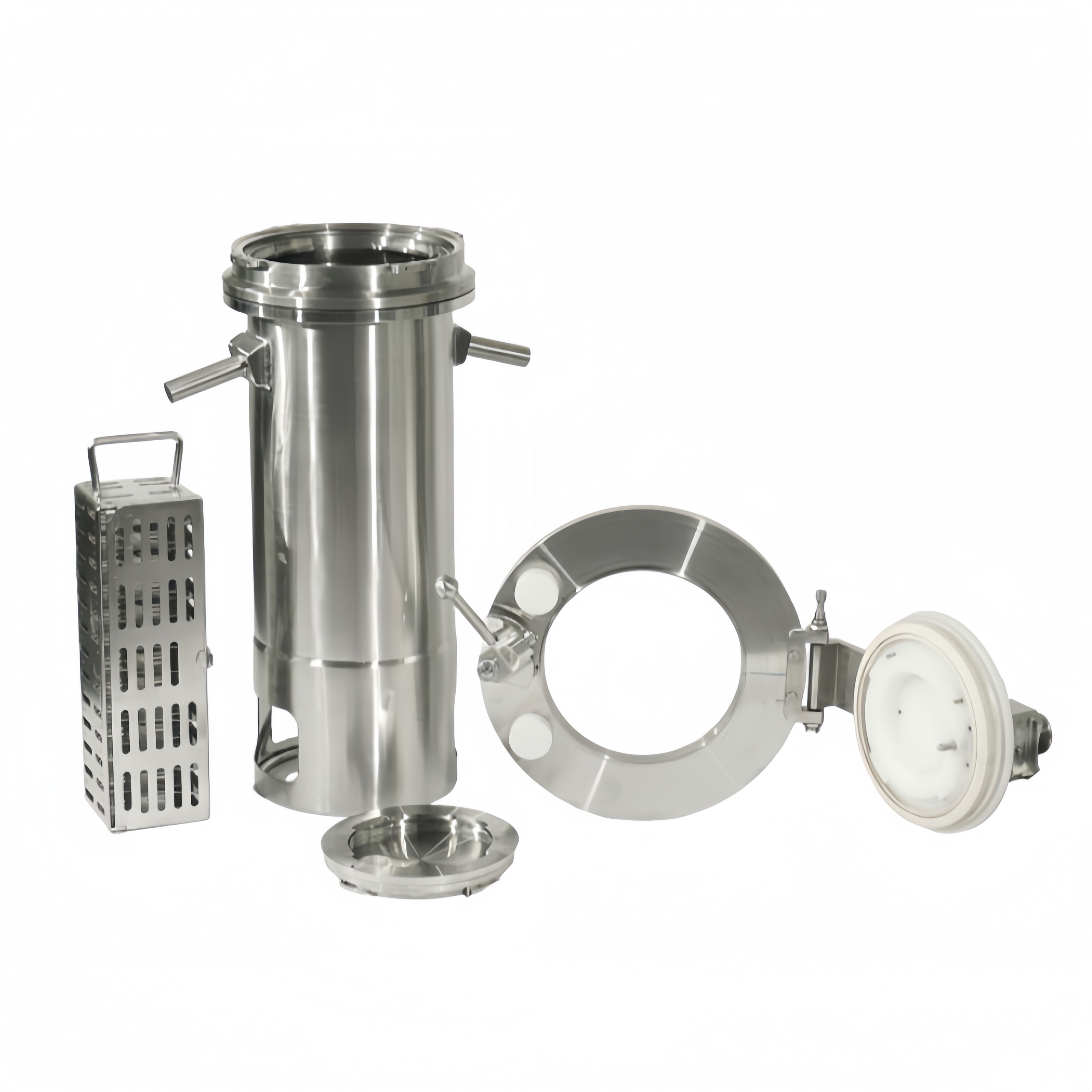
Keeping a cleanroom clean sounds simple until you start moving liquids and powders through its walls. Every time a container crosses the barrier, pressure differences and human hands invite contamination in. Double-door isolation, where a pass-through chamber has interlocked doors on both sides, forces a physical pause. You can't open the far door until the near one seals, and that mandatory dwell time changes how people behave. It turns what used to be a rushed handoff into a deliberate, staged transfer.
For sterile liquids, a single open doorway is a jet of unfiltered air. Even with positive room pressure, a bottle carried through creates turbulence that pulls corridor particles inward. Powder handling is worse: fine dust hangs in the air, clings to gloves, and drifts through any gap. A double-door isolator doesn't rely on airflow alone. It uses mechanical interlocking and often a flush cycle or UV pass. The product sits in a small, contained volume while the operator switches sides, so the main room never sees a direct opening.
There's also a practical reason this design persists. Single-door transfers lead to shortcut habits: propping a door open, passing items over a threshold, or stacking batches to save time. Double-door isolation removes those options. It enforces a sequence, and that sequence becomes part of the SOP without extra supervision. In sterile production, where a single failed batch can cost more than the isolator itself, that built-in discipline is worth the extra square footage.
From Biohazard to Cleanroom: The Containment Chain Without a Single Break
Handling hazardous biological materials demands more than isolated precautions—it requires an unbroken sequence of controls that begins the moment a sample is identified. Every transfer, every surface contact, every air exchange is treated as a potential breach point. From sealed primary containers to verified decontamination procedures, the goal is to prevent any viable agent from escaping its designated zone. This isn't simply about following a checklist; it's about engineering each step so that containment remains intact even when human attention wavers.
The transition into a cleanroom environment is where many containment strategies falter, but a well-designed chain treats this boundary as a critical interface rather than a barrier to cross. Materials pass through airlocks that maintain pressure differentials, surfaces are wiped with sporicidal agents, and personnel move through staged gowning rooms that strip away contaminants layer by layer. The cleanroom itself becomes an extension of the containment logic: just as nothing hazardous should leave the biohazard zone, nothing particulate should enter the cleanroom uninvited. The two objectives—keeping hazards in and keeping impurities out—merge into a single, coherent discipline.
What makes the chain genuinely unbreakable is the absence of reliance on any single point of failure. Redundant filters, continuous environmental monitoring, and fail-safe interlock systems ensure that if one element degrades, the next absorbs the load without compromising the whole. Training reinforces this redundancy, so that every operator understands not just the procedure but the reasoning behind it. The result is a workflow where biohazard containment and cleanroom sterility are not competing priorities but two faces of the same commitment: no particle, no organism, no compromise crosses the boundary uninvited.
Redesigning Cleanroom Workflows: Faster Material Pass-Through Without Airflow Disruption
Traditional cleanroom material transfer often forces a choice between speed and contamination control. Long waits at airlocks, repeated decontamination cycles, and manual log entries add minutes to every batch. The redesign targets this bottleneck directly: pass-through chambers are repositioned closer to point-of-use, and their internal surfaces are re-engineered to shed particles more easily. Rather than relying on a single large pass-through for all material types, the layout now separates high-turnover consumables from occasional large equipment moves, so routine transfers no longer queue behind infrequent, bulky items.
A key shift is the move to active, HEPA-filtered pass-through units with fast purge cycles and interlocked doors that do not fight the room's pressure cascade. Instead of waiting for a fixed timer, the chamber monitors particle counts and releases the clean-side door only when the measured level falls below the target limit. This allows the cycle to end in half the previous time under good conditions, while still holding the line if an operator introduces a soiled container. The hardware changes are paired with a simpler digital handoff: barcode scans replace paper logs, so each transfer is recorded without a pause at a terminal.
The result is a material flow that moves at the pace of production rather than the pace of the airlock. Operators spend less time standing at the boundary, which also reduces the number of door openings and the associated turbulence. Airflow visualization and particle monitoring during pilot runs showed no increase in excursions at the pass-through, confirming that the faster cycle did not compromise the clean zone. Because the new sequence is easier to follow, training time drops and compliance becomes less dependent on supervision.
Comparing Alpha Ports, Beta Ports, and Automated RTP Systems
When you stack Alpha Ports next to Beta Ports, the differences are rarely about raw speed or headline capacity. Alpha builds tend to favor deterministic routing paths and hands-on queue tuning, which suits teams that want to see exactly where every packet flight lands. Beta Ports usually trade that granular control for easier scaling and a broader set of default policies, often leaning on heuristic rebalancing that keeps things moving without a dedicated traffic engineer watching the dashboards. Neither approach is wrong—it comes down to whether your team values predictable internals or adaptive shortcuts.
Automated RTP Systems introduce a different axis altogether. Instead of asking you to choose between Alpha and Beta port behaviors, they wrap real-time transport decisions into a continuous feedback loop. The system watches jitter, loss, and latency across active sessions, then adjusts buffering, retransmission, or codec parameters on the fly. Compared to manually configured Alpha or Beta ports, an automated RTP layer reduces the operational burden when traffic patterns shift suddenly—think a regional failover or an unplanned spike in interactive media. The tradeoff is that you give up some of the fine-grained control that Alpha setups excel at, and you need to trust the automation's telemetry thresholds.
In practice, many deployments blend these models rather than picking one. You might run Alpha Ports for mission-critical trunk links where every millisecond is audited, Beta Ports for general-purpose media routing that can tolerate occasional reordering, and an automated RTP system as an overlay that only intervenes when conditions cross a defined comfort zone. The key is to measure where your current pain actually lives: if troubleshooting eats more time than scaling, automation looks attractive; if you need reproducible, line-by-line behavior for compliance or debugging, Alpha port configurability still earns its keep.
The Human Factor: Training and Ergonomics in Rapid Transfer Operations
In rapid transfer operations, the margin between a clean handoff and a costly spill often comes down to how well personnel are trained to read subtle cues—equipment strain, load shift, or a colleague's hesitation. Standardized drills help, but the real differentiator is scenario-based training that puts operators in imperfect conditions: low visibility, uneven surfaces, time pressure. Those who have practiced failure modes are less likely to freeze when the unexpected happens.
Ergonomics is frequently treated as an afterthought in transfer logistics, yet it directly shapes both speed and injury rates. A well-designed transfer station reduces unnecessary twisting, reaching, and lifting by aligning conveyor heights with natural elbow positions and placing controls within a comfortable arc. When operators aren't fighting their workspace, handoffs become smoother and fewer micro-delays accumulate across a shift.
Fatigue management ties the two together. Rotating roles between high-attention monitoring and physical handling prevents the tunnel vision that leads to misjudged clearances or dropped loads. Brief, structured handover pauses—where the next operator repeats back the load characteristics and any anomalies—cost seconds but prevent the kind of errors that halt an entire line for hours.
FAQ
It's a double-door system mounted between two environments with different cleanliness levels. The alpha port is fixed to a wall or isolator, while the beta flange attaches to a transfer container. When docked, both doors interlock and open together, so material can pass through without exposing either side to outside air.
The mating surfaces form a sealed interface before either door opens. Because the doors remain locked together and the small gap between them is isolated, any particles trapped at the interface stay contained. The operator never touches the sterile side, and the transfer container's interior remains closed until the dock is confirmed.
They eliminate the need for repeated wiping, bagging, and decontamination cycles. A single dock-and-transfer action takes seconds rather than minutes. In high-throughput facilities, that time saving compounds quickly, especially when moving small components or tools multiple times per shift.
They handle solids, liquids, and powders, but the design details change. For liquids, you'd typically use a sealed container with a beta flange that mates without splashing. For powders, careful attention to the sealing gasket and extraction ring prevents dust from escaping during docking and undocking.
Wall thickness, available clearance around the opening, and the weight of transfer containers matter. You also need to evaluate how the port's flange will be sealed to the wall panel without creating crevices. It is often easier to plan for them in new construction, but retrofits are feasible with custom frames.
A mechanical interlock prevents the beta door from being released unless the alpha door is closed and latched. Many systems also have a visual indicator or a physical key that only turns when sealing is complete. Training still matters, but the interlock reduces reliance on memory.
Yes. Some are designed for aseptic processes where the main goal is keeping microorganisms out. Others are for potent compound handling where the priority is keeping hazardous material in. The choice affects gasket materials, pressure differentials, and whether you need an active extraction ring.
Inspect the gaskets for wear or cracking, lubricate the interlock mechanism with cleanroom-approved grease, and periodically verify the seal with a pressure decay test or aerosol challenge. Door alignment should be checked if docking feels stiff. Replacing worn parts before they fail is much cheaper than a contamination event.
Conclusion
Rapid transfer port (RTP) solutions have quietly reshaped how cleanrooms handle everything from sterile liquids to potent compounds. At their core, these systems rely on a double-door isolation mechanism—an alpha port fixed to the barrier and a beta container that docks and seals before the doors open together. This design keeps the transfer zone fully enclosed, so even sensitive powder or liquid transfers never expose the interior to room air. The sealing surfaces are engineered to withstand repeated use without losing integrity, and the swappable beta units let operators move materials in and out with a fraction of the effort older pass-through chambers demanded. Because the two doors interlock mechanically, there is no moment where both sides are open at once, which is exactly why high-containment and aseptic processes trust them over simple airlocks.
Beyond the hardware, the real value shows up in how workflows change. A properly placed RTP line can move biohazardous waste out and sterile components in without breaking the containment chain—something traditional material locks struggle to match. Automated RTP systems add another layer by reducing manual docking steps, while manual alpha and beta ports still win on flexibility and cost. Yet none of that matters if operators aren't trained to align the docking collar correctly or to read the pressure differential indicators. Ergonomics also play a hidden role: a port positioned too low or too high invites mistakes. When the mechanics, automation level, and human factors are balanced, rapid transfer ports stop being just an equipment upgrade and become the backbone of a faster, safer cleanroom operation.
Contact Us
Contact Person: Ananda
Email: [email protected]
Tel/WhatsApp: 8619016718200
Website: https://www.wzaomi.com