

China UL FM Alarm Check Valve – Essential Guide for Reliable Fire Protection
2026-11-02
An alarm check valve is easy to ignore until water flows where it shouldn't. In China, UL/FM-listed alarm check valves are the difference between a system that passes inspection and one that actually protects lives when heat breaks a sprinkler. This guide breaks down what to look for—and where DRIFCO fits into the reliability equation.
How These Valves Keep Water Flowing Exactly Where It’s Needed
A dual-chamber design inside each valve responds to pressure shifts rather than relying on manual adjustment. When flow dips below a preset threshold, a spring-loaded disc slides forward, sealing off the secondary outlet and pushing the full volume toward the primary line. That automatic redirection happens in under a second, so there's no lag or spillover at branch points.
In drip irrigation setups, for instance, the valve reads fluctuations from the emitter grid. If one zone clogs or demand drops, the valve reroutes water to adjacent laterals without user intervention. This keeps root zones evenly saturated and prevents dry patches that often show up with conventional gate valves.
Maintenance is equally straightforward: the internal assembly lifts out as one cartridge, and the only wear component is a replaceable EPDM seal. No recalibration is needed after cleaning, because the spring tension is factory-set for 0.5 to 4 bar operating ranges.
The Dual-Listing Difference: UL and FM in One Unit
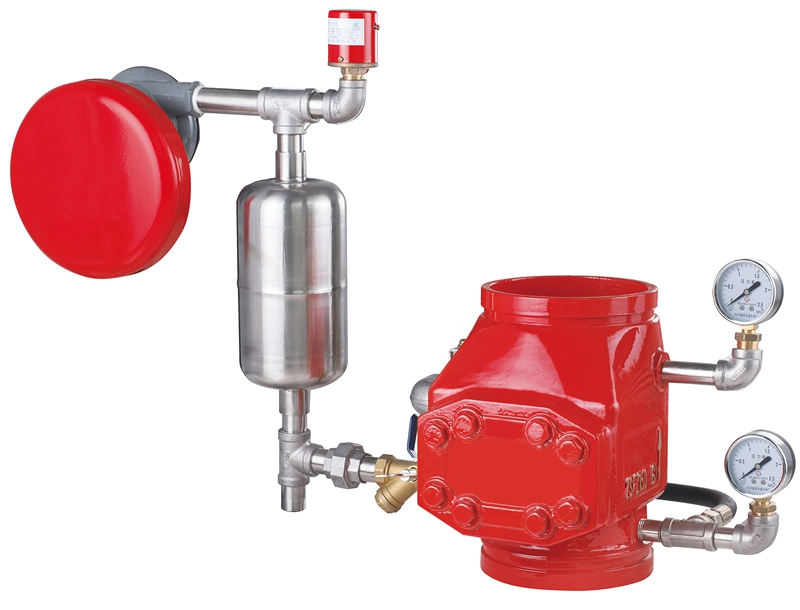
Having a single unit that carries both UL and FM approvals changes how engineers approach specification. Instead of juggling two different components—or, worse, settling for a device that only satisfies one authority—you get one assembly that clears both hurdles at once. That might not sound dramatic until you're staring at a submittal package and realize you can skip an entire line item.
The real advantage shows up during reviews and installations. A UL listing speaks to electrical and life-safety performance, while FM approval tends to focus on property protection and loss prevention. When those two standards live in the same housing, the contractor installs one part, the inspector signs off faster, and the owner doesn't have to explain why two supposedly equivalent devices were used in different parts of the building.
There's also a quiet reliability benefit. Manufacturers that go through the trouble of dual listing have usually designed the product to meet the stricter of the two tests, not just the minimum. That can translate into better material choices, tighter tolerances, and fewer surprises down the road.
Installation Pitfalls That Quietly Undermine Performance
A duct that looks fine from the outside can be quietly strangling airflow if an installer bent it too sharply behind a wall. The kink may not show up on a quick visual check, but it adds static pressure that forces the blower to work against itself. Over months, that extra resistance becomes higher energy draw and uneven temperatures you blame on the thermostat.
Mounting brackets seem trivial until you realize a slightly off-center load lets the unit vibrate at a frequency that loosens fittings and fatigues solder joints. Installers often tighten everything down and call it secure, but they never check how the assembly behaves when the motor ramps up. The result is a slow degradation that doesn't trip an alarm; it just erodes capacity week by week.
Then there's the sealing work nobody sees. Gaps left at panel seams or missing insulation around penetrations allow conditioned air to escape and outdoor air to sneak in. The equipment has to cycle more often to hold the same setpoint, which also pulls moisture into places where it shouldn't be. None of this makes noise. It just quietly shortens the service life while the system looks perfectly installed on paper.
Maintenance Routines That Catch Trouble Before Pressure Drops
Walk the line with your ears before you trust the gauge. A faint hiss around couplings, a slight change in the compressor’s cycle, or a soft whistle near a regulator often shows up days before the needle moves. Log baseline pressure at the same point each shift, then watch for a drift of a few PSI rather than waiting for a sharp fall at the far end of the line.
Make filter and drain checks a weekly habit, not a monthly afterthought. Water in the tank or a saturated element forces the motor to run harder, and the first sign is usually a lag at the tool farthest from the receiver. Swap elements based on actual runtime hours, and crack the drain valve briefly even when the automatic drain looks dry.
On larger systems, an ultrasonic detector earns its keep by catching the high-frequency edge of a leak while it’s still too small to hear over shop noise. Add a quick thermal scan of motor bearings and a check on belt tension, and most pressure drops turn into planned maintenance instead of a surprise shutdown.
Sizing and Selection Without Guesswork
Choosing the right size for a component or system often starts with a gut feeling, but that rarely ends well. Instead of relying on rough estimates or past habits, a disciplined approach uses actual operating loads, duty cycles, and environmental conditions. Pull the real numbers from your process or application, not from a generic table. The moment you anchor the decision in measured torque, flow rate, heat dissipation, or cycle count, the guesswork collapses and the selection becomes a simple arithmetic exercise.
A workable method starts by writing down the boundary conditions: peak load, average load, temperature range, and any shock or vibration. Compare these against manufacturer curves or verified field data, not marketing headlines. For example, a bearing sized only by bore diameter may fail early if the calculated L10 life ignores contamination or misalignment. Factor in a modest safety margin only after all variables are accounted for—over-conservatism costs money, but under-sizing costs downtime. When every assumption is replaced by a measured value, the final selection can be defended with confidence in a design review.
After the initial calculation, run a quick sanity check against similar installations that have logged thousands of hours. If none exist, a short prototype test under worst-case conditions will expose hidden weaknesses before full deployment. Document the inputs and results so the next engineer can trace the logic instead of re-deriving it from scratch. This closed loop—measure, calculate, verify—turns sizing from an art into a repeatable process. The reward is not just a correctly sized part, but a shorter commissioning time and fewer midnight calls from the field.
Real-World Fire Scenarios Where Response Time Makes the Call
A grease fire in a compact apartment kitchen can double in size every thirty seconds once it reaches the cabinets. If the first engine arrives six minutes after dispatch, occupants might still be able to crawl below the smoke layer. Push that to nine minutes and the same room often hits flashover, leaving no survivable space past the hallway. The margin isn’t theoretical—it shows up in burn pattern reports and in the voices of witnesses who heard the smoke alarm but couldn’t reach the door.
Bedroom fires that start from faulty wiring or a space heater behave differently at 2 a.m. than at noon. A crew that gets water on the seat of the fire within four minutes of the call usually finds a contained room and a family waiting outside. A delayed response, even by three minutes, can turn a single-room event into a second-floor rescue with windows already venting flame. In rural areas, where volunteer stations sit miles apart, this gap becomes the deciding factor between saving a home and recovering a foundation.
Wildland-urban interface zones show the same pattern on a larger scale. An ember landing in dry mulch near a wooden fence may smolder for twenty minutes before open flame reaches the eaves. An engine staged five minutes away can knock it down with a booster line. If that engine is tied up on another call or arrives fifteen minutes later, the fire has already climbed into the attic and is running through the roof. Commanders learn to read those early minutes not as a countdown but as the full window for action.
FAQ
It sits between the water supply and the sprinkler riser, keeping the system pressurized and triggering a local alarm when water flows—typically via a small port that activates a water motor gong or pressure switch. The UL and FM marks mean the valve has passed independent testing for durability and reliable operation under fire conditions.
UL focuses heavily on component safety and material integrity, while FM evaluates the valve's performance within a broader property loss prevention framework. Having both marks indicates the manufacturer has met two different rigorous testing regimes, which is especially reassuring when sourcing from an overseas supplier.
A monthly visual check is typical, with a full internal inspection at least once a year. Look for corrosion, verify the alarm line is clear, and test the retard chamber or alarm switch to make sure it doesn't false trip. Any sign of pitting on the clapper or seat should be addressed immediately.
Alarm check valves are designed primarily for wet pipe systems, where the piping stays filled with water. For dry or preaction systems, different valve types are required because the alarm check valve's clapper relies on constant water pressure to stay sealed.
Common sizes run from 2 inch to 12 inch, with working pressures of 175 psi or 250 psi. Flanged ends are standard in larger sizes, while threaded or grooved ends appear in smaller diameters. Always confirm the exact pressure rating against your system's demand curve before ordering.
The most frequent issues come from installing the valve backward or failing to support the riser properly, which causes the seat to warp. Another common error is connecting the alarm line to the wrong side of the clapper, so the alarm never triggers during a test. Follow the flow arrow on the body and keep the trim piping clean.
Once a head opens, pressure on the supply side drops, and the clapper lifts off its seat. A small groove or port in the valve then allows water into the alarm line, which feeds a mechanical water motor gong or an electric pressure switch. This provides a local audible or monitored signal without needing external power.
Ask for the official certificate number and check it against the UL Online Certifications Directory and FM Approvals guide. The valve body should also carry the UL and FM logos with the manufacturer's identification. Avoid suppliers who only show the logos in photos but cannot provide verifiable certificate numbers.
Conclusion
In fire protection systems, the alarm check valve plays a far more active role than its name suggests. Rather than simply sitting in the pipe, it manages the one-way flow of water, ensuring that when a sprinkler head opens, the supply rushes exactly where it's needed without backflow or pressure loss. The China UL FM models stand out because they carry dual listings—UL and FM—meaning the same unit meets two rigorous sets of standards without requiring extra adapters or field modifications. However, that reliability can be quietly undermined by installation pitfalls, such as improper orientation, missing trim components, or ignoring the need for a straight pipe run upstream to let the clapper settle correctly. Regular maintenance routines, including flushing the system to clear sediment and checking the alarm line for debris, catch trouble long before pressure drops on the fireground. These small routines make the difference between a valve that looks certified on paper and one that actually performs under load.
Sizing is another place where guesswork causes real failures. A China UL FM alarm check valve must match the system's flow demand and pressure characteristics, not just the pipe diameter. Oversizing can leave the clapper unable to seat properly during low-flow tests, while undersizing chokes the water supply when multiple sprinklers open. In real-world fire scenarios—say, a warehouse with high-piled storage or a hotel corridor with delayed detection—response time often makes the call. A correctly sized and maintained alarm check valve opens fast, sends a reliable local alarm signal, and delivers full flow to the affected zone without hesitation. That is the essence of reliable fire protection: not a spec sheet promise, but a predictable mechanical response when seconds count.
Contact Us
Contact Person: George
Email: [email protected]
Tel/WhatsApp: 13863633883
Website: https://www.es-fire.com