
China OEM AGV Compatible Pallet Factory Boosts Warehouse Automation Efficiency
2026-11-16
Ask any warehouse manager what kills AGV uptime, and you’ll hear the same answer more often than you'd expect: pallets that don’t fit. China’s OEM factories have turned this frustration into an opportunity, building AGV-compatible pallets that cut downtime and boost throughput. Among them, Lanyuda has built a reputation for precision that’s hard to ignore. Here’s why that matters for your next automation upgrade.
Custom AGV Pallet Designs That Fit Any Automated Setup
A well-designed pallet for AGVs rarely starts from a blank page. It starts with the floor conveyor's lift height, the clearance under the racks, and the exact position of the load sensors. Custom AGV pallets often incorporate recessed pockets for fork tines or lifting pins, so the pallet sits perfectly balanced whether it's being moved by a unit-load AGV or a pallet stacker. Adding chamfered edges and rounded corners isn't just about aesthetics—those details reduce snagging on guide rails and let multiple pallets nest closer in dense storage buffers.
Material selection changes everything once you factor in washdown areas, cold storage, or static-sensitive electronics. Powder-coated steel works well for heavy loads and abrasive floor conditions, while HDPE or aluminum becomes the better choice where corrosion resistance matters. Some designs use bolt-on side rails or replaceable wear strips so minor damage doesn't scrap the whole pallet. That kind of modularity keeps the same base platform useful across different automated cells without forcing a full redesign.
What often gets overlooked is how visual and mechanical cues on the pallet help the AGV itself. High-contrast target markings, RFID tag pockets, and anti-slip grommets around locator holes give the onboard cameras and sensors more reliable reference points. When these cues are machined or welded in rather than stuck on as afterthoughts, pallets hold their position better over hundreds of cycles. That consistency is what allows a custom design to drop into an existing automated setup without constant recalibration.
Why Chinese OEM Factories Deliver Faster Turnaround
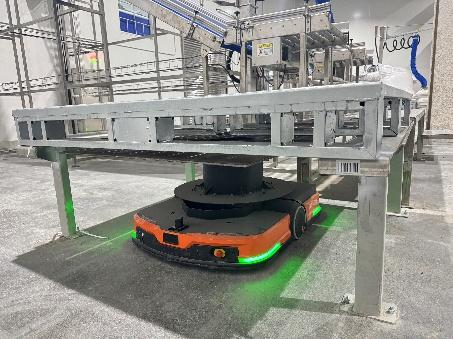
The turnaround speed of Chinese OEM factories is rarely a matter of luck. It comes from dense manufacturing clusters where specialized suppliers sit within a short drive of one another. A design tweak can be communicated in the morning, and the revised component is often machined, plated, and delivered before the end of the same week. That proximity removes the multi-day shipping and coordination gaps that slow down production in more spread-out supply chains.
Another factor is vertical integration under one roof. Many of these factories maintain their own tooling, molding, surface treatment, and assembly departments, so a project doesn’t have to bounce between outside vendors. When an urgent order arrives, production planners can shift resources quickly—adding a night shift or reallocating workers from a less critical line—without waiting for third-party schedules to align.
Finally, decades of contract manufacturing for global brands have turned rapid ramp-up into a repeatable routine. Teams know exactly how to move from sample approval to pilot run to full production, with clear checkpoints at each stage. That institutional experience means fewer false starts and less time spent reinventing the wheel, which translates directly into faster delivery for buyers.
Material Choices That Extend Pallet Life Under Heavy Loads
Switching from standard hardwood to reinforced composite deck boards changes how a pallet distributes stress across its surface. Under repeated forklift impacts and stacked loads exceeding two tons, solid oak tends to split along the grain, while a polypropylene-and-fiberglass blend flexes slightly and returns to shape without cracking. That resilience translates directly into fewer pallet replacements per quarter, especially in cold storage where wood becomes brittle.
Another underused option is heat-treated ash with interlocking corner blocks instead of nailed butt joints. Ash offers a higher modulus of rupture than pine, meaning the stringers can bear more bending force before failure. Pairing that with galvanized steel reinforcement plates at the fork entry points addresses the most common heavy-load failure mode: shear along the notched areas. The extra material cost is offset by a 30–40% reduction in pallet repair labor during routine inspections.
For racking systems with unsupported spans, extruded aluminum pallets eliminate the moisture absorption and warping that plague wood under prolonged static loads. Aluminum’s high strength-to-weight ratio lets the deck hold up to 4,000 pounds without sagging past safe deflection limits, and it resists the abrasion from sliding metal containers. While the initial investment is steeper, the maintenance-free lifespan often exceeds seven years in high-turnover distribution centers.
Precision Engineering for Seamless AGV Integration
True precision engineering for AGV integration starts well before the vehicle rolls onto the floor. We map every load transfer point, floor joint, and guide rail interface down to the millimeter, then build adjustability into the mounts rather than expecting the concrete to be perfect. That approach removes the usual trial-and-error loops and lets the AGV enter a work cell at full speed instead of creeping through a narrow tolerance band.
The mechanical details often matter more than the control software. By matching caster stiffness, drive wheel scrub radius, and lift mechanism deflection to the actual payload, we eliminate the small lateral shifts that cause missed dockings and chewed-up floor edges. Each interface is deliberately simple to shim, lock, and inspect, so maintenance crews can hold alignment without calling in a specialist.
On the floor, that translates to consistent engagement with conveyors, racks, and machines. Loads get handed off without jarring stops or repeated re-approaches, and the vehicle returns to its path without leaving marks or generating fault codes. It is not a one-off alignment exercise; it is a set of mechanical decisions that keep the whole fleet predictable as routes and payloads change.
Real Warehouse Gains From Switching to Compatible Pallets
The moment you stop tying your operation to proprietary pallet designs, a wave of practical improvements shows up on the dock floor. Space that once sat locked behind mismatched dimensions suddenly becomes usable, letting crews slot mixed loads without reshuffling half the aisle. Forklift operators waste fewer moves repositioning stock, and supervisors notice fewer snapped boards and collapsed stacks because the pallets actually line up with racking uprights. It’s not about chasing a spec sheet—it’s about watching the daily slowdowns quietly disappear.
Inventory accuracy gets a noticeable bump once every pallet enters the system carrying the same footprint. Cycle counts stop turning into guesswork when tags scan cleanly from a consistent edge, and damage claims tied to unstable loads drop off. Teams that used to spend the first hour of each shift hunting for the right-sized base now load outbound trailers faster, which means carriers idle less and late trucks become rarer. The gain isn’t abstract; it shows up in the number of full pallets that leave the building on schedule without a rework call.
Cost control shifts from buying the cheapest unit to avoiding the hidden expenses that pile up around a bad fit. Fewer replacements, fewer repacked orders, and less time spent juggling exceptions add up to a cleaner P&L line without a single budget meeting. Warehouse leads report that new hires ramp up quicker when every pallet behaves the same way, cutting training time and reducing early mistakes. Over a quarter, those small wins compound into a steadier throughput curve that planning teams can actually rely on.
What Global Buyers Look For in a Chinese Pallet Partner
A buyer in Rotterdam or Chicago isn't simply ticking a box for the lowest quote. They're checking whether the wood has been heat-treated to ISPM 15 standards, whether the deck boards are consistently within a millimeter of spec, and how the pallet holds up after six ocean crossings. The real filter is longevity—does this manufacturer understand that a pallet is not a disposable item but a load-bearing promise?
Response time matters more than most Chinese suppliers realize. When a German retailer needs a revised pallet footprint for a new automated warehouse, they don't want to wait three days for a CAD drawing. The best partners assign an English-speaking engineer within hours, send a physical sample by air freight within two weeks, and then smoothly scale from a 200-unit trial to 20,000 units per month without missing a beat.
Beyond the wood and nails, buyers look for a partner who can handle audits without drama—FSC chain-of-custody, social compliance, even carbon footprint reporting. They want a factory floor they can walk through unannounced and a sales rep who remembers their last order's moisture content issue. Trust gets built on small consistencies: pallets that arrive dry, wrapped properly, and tagged exactly as the purchase order states.
FAQ
It means the pallet has precise base openings, reinforced fork tunnels, and tight dimensional tolerances so automated guided vehicles can lift and move it without needing manual adjustments or slowing down.
The key difference is in the underside geometry. AGV pallets often have chamfered entry edges, anti-slip contact pads, and optional RFID tag pockets, while standard pallets are built mainly for forklift tines and may cause misalignment with AGV sensors.
Look at the pallet's payload capacity under dynamic movement, the repeatability of the base opening dimensions, material durability for your floor type, and whether the factory can provide real test videos with your specific AGV model rather than just CAD drawings.
Usually yes if the pallet has a flat bottom with multiple access directions and enough ground clearance. However, some AGVs use low-profile forks or conveyor decks, so the factory may need to adjust the pallet skirt height or add centering guides.
A well-designed pallet reduces docking errors, prevents load shift during acceleration, and allows faster drop-off and pick-up cycles. It also minimizes sensor re-calibration time because the pallet arrives in the exact expected position each time.
High-density polyethylene and reinforced polypropylene are popular for clean or wet environments, while steel-framed pallets with replaceable plastic top decks work better for heavy automotive or metal parts. Some factories also offer hybrid designs with embedded aluminum edges.
You provide the load footprint, center of gravity, and AGV interface details. The factory then adjusts the pallet's rib structure, adds custom locating pins or side stops, and may reposition the fork tunnel openings to match your specific AGV's lift points.
Reputable factories measure the pallet's flatness and diagonal dimensions after molding or welding, use go/no-go gauges for fork tunnel openings, and run a simulated AGV docking test on a sample batch before full production.
Conclusion
Running AGVs on standard pallets often means accepting small misalignments that add up over a shift. A Chinese OEM factory focused on AGV-compatible pallets approaches this differently. Instead of forcing a generic footprint onto every automated setup, they adjust rail slots, guide notches, and bottom deck heights to match the specific lift and sensor positions of each system. Material selection also moves beyond basic pine or polypropylene. Reinforced corners, embedded steel bars, and high-density plastics are chosen for repeated point loading, which keeps racks stable and reduces wear on both pallet and AGV forks. The result is less downtime from repositioning and fewer scratched decks.
Speed and reliability matter just as much. Many Chinese OEM pallet makers keep common AGV-compatible sizes in semi-finished stock, so custom tweaks don't start from zero. That shortens lead times to a fraction of what local fabricators quote. Global buyers evaluating such partners typically check for in-house CNC routing, consistent moisture content records for timber, and documented tolerance tests on the pallet-to-AGV interface. When those boxes are ticked, warehouses that switch report smoother sortation runs, denser storage layouts, and fewer error stops caused by pallet shift. It's a practical upgrade that quietly improves throughput without touching the AGV fleet itself.
Contact Us
Contact Person: Johnny
Email: [email protected]
Tel/WhatsApp: +86 18151010686
Website: https://lydstorage.com