

China Four Major Series Gear Motors Manufacturer Provides Reliable Power Transmission Solutions
2026-10-07
Most gear motor failures don't announce themselves. They show up as unexpected downtime, delayed orders, and a maintenance team under pressure. That's why the four major series gear motors from China have become a go-to choice for engineers who need power transmission they can count on. As a manufacturer at the center of this demand, Chuangjuman delivers reliable solutions that keep lines running. Here's what you should know before you buy.
Four Gear Motor Families That Simplify Drive Selection for Mixed Loads
Mixed load profiles can force engineers to compromise on either torque, speed, or footprint. Four gear motor families eliminate that trade-off by covering a spectrum that ranges from high-efficiency inline helical units to compact right-angle designs. Instead of spec'ing different drives for each axis or process, one family often handles multiple load points without derating or oversizing.
What makes these families practical is their modularity. The same gearhead accepts different motor attachments, ratios, and mounting options, so a single platform can match intermittent high-torque moves and continuous low-speed duties. Plant maintenance also becomes simpler: fewer spare parts, familiar service procedures, and predictable lead times across all four sizes.
Why Case-Hardened Helical Teeth Change the Noise and Lifespan Equation
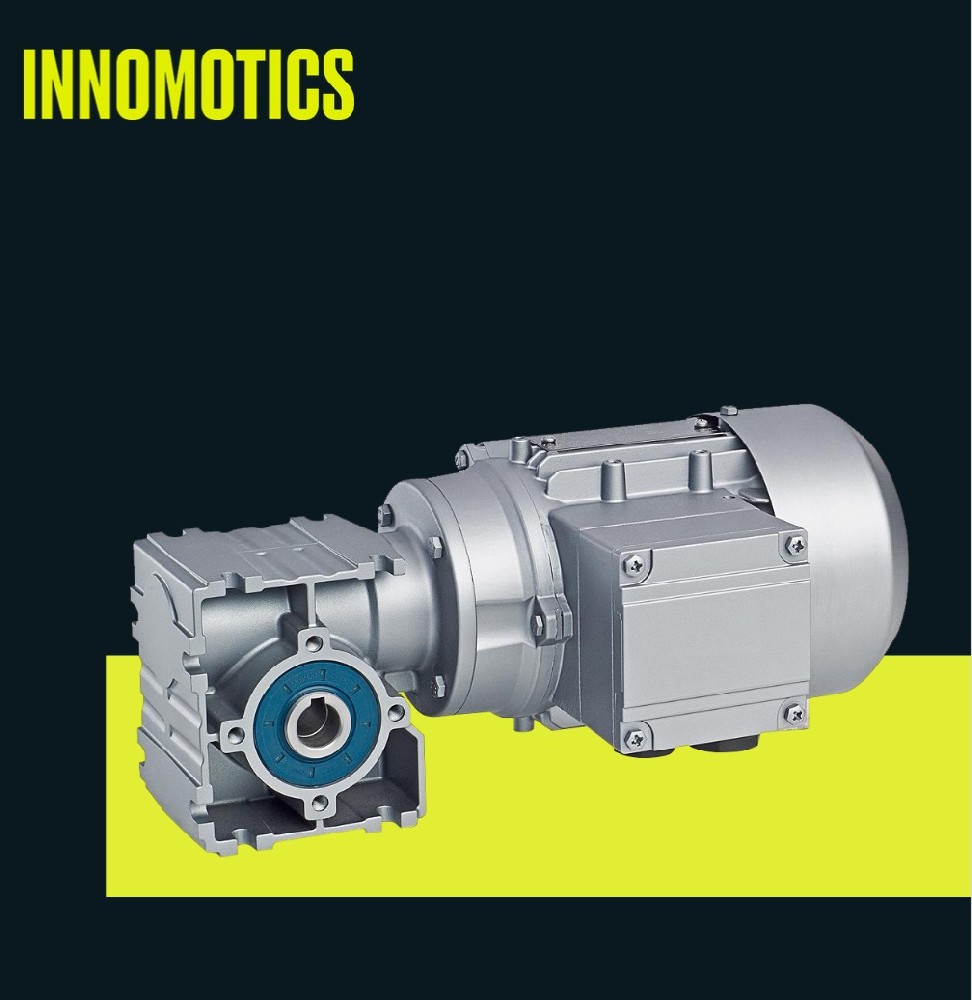
Helical teeth already engage gradually, spreading load across a longer contact line than spur teeth. Add case hardening and the surface becomes a hard, wear-resistant shell around a tougher core. This combination shifts the failure mode away from pitting and micropitting, which are major noise sources as surfaces degrade. A stable, polished flank holds its profile longer, so transmission error doesn't creep upward over time the way it does with softer gears.
There's a catch, though. Case hardening introduces residual stresses, and the heat treatment can leave slight dimensional changes. If those aren't corrected by final grinding or honing, the tooth profile errors create a tonal whine that wasn't there before hardening. The helical angle helps mask some of that by keeping more teeth in mesh, but it can't fully compensate for a sloppy post-heat-treatment finish.
Lifespan also depends on case depth and core hardness. Too shallow a case and the hardened layer can spall under heavy contact stress; too deep and the tooth becomes brittle, risking fracture from impact loads. When the depth is matched to the expected load spectrum, the compressive residual stress at the surface actually slows crack initiation. That yields a gearbox that stays quiet for longer and resists the usual fatigue failures at the flank and root.
Right-Angle Stages: Bevel and Worm Options Compared Under Real Torque
You only notice the real differences between bevel and worm right-angle stages when torque stays high for minutes, not milliseconds. A bevel set converts direction with almost no sliding, so the housing stays cooler and efficiency rarely drops below 90% even at rated load. That matters more than the spec sheet suggests, because heat is what eventually loosens preload and opens backlash. Worm stages pay a thermal penalty right where it hurts: under continuous torque, the sliding contact generates enough heat to change mesh clearance, so a stage that felt tight on the bench can develop a dead band after an hour of real work.
Stiffness is another area where the two diverge under load. A preloaded bevel pair spreads force across multiple teeth, which keeps windup low and makes the stage predictable when reversing. Worm drives put all the load through one or two teeth, but the steep reduction ratio gives them a mechanical advantage that can mask some of that compliance until you push past peak torque. If the application cycles between forward and reverse with a heavy tool, bevel stages tend to hold position better without constant adjustment. If it mainly needs high ratio in a small envelope and can tolerate a warm gearbox, a worm unit still earns its place.
Thermal Margins in Continuous Duty: What Nameplate Ratings Don't Tell You
Engraved on the nameplate, a continuous-duty motor's temperature rise is usually tied to a single set of laboratory conditions—often a 40°C ambient, sea-level altitude, and a clean sine-wave supply. On the factory floor, though, those assumptions buckle. A few degrees hotter inside the enclosure, a slightly choked air filter, or a voltage imbalance of just 2 or 3 percent can push the windings well past the nameplate's implied thermal cushion. That margin isn't a fixed guarantee; it's a snapshot taken under conditions your installation may never see.
What rarely surfaces in catalog data is the time constant of the machine. Continuous duty doesn't mean the motor reaches thermal equilibrium in minutes. A large frame can take four to eight hours to stabilize, and during that slow climb the insulation is aging in ways not captured by a single steady-state number. If the load cycles or the cooling air temperature swings between shifts, the winding hotspot drifts accordingly—sometimes lingering above the class limit without tripping any protection.
There's also the matter of how nameplate ratings are interpreted. A Class F insulation system with a Class B temperature rise is often quoted as having a built-in thermal margin, but that extra allowance isn't free. Running hotter to use that margin may shorten insulation life more than expected, especially if the motor is already coping with harmonic heating or accumulated dust on the cooling fins. In practice, the real thermal margin is the difference between the actual hotspot temperature and the insulation's aging threshold—not the gap between two printed numbers.
How Chinese Assembly Lines Keep Backlash Consistent Across Large Batches
Maintaining consistent backlash across large batches starts with rigid fixturing and precision assembly rather than relying on post-build adjustment. Chinese lines often use dedicated press-in stations with servo-controlled force and position feedback, so each gear or spline is seated to the same depth and preload every time. The tooling itself is periodically re-qualified with master gauges, and any drift beyond a few microns triggers an automatic stop before defective units can accumulate.
In-process measurement plays a bigger role than final inspection. Vision systems and laser displacement sensors sample every Nth assembly, feeding data into statistical process control charts that track backlash distribution in real time. If the spread starts to widen even while staying within tolerance, operators swap out worn mandrels or adjust bearing shim thicknesses immediately. This closed-loop feedback keeps the entire batch tightly clustered around the nominal value instead of letting small variations compound over thousands of units.
Worker training and standardized work instructions are engineered to reduce human-induced scatter. Torque sequences, lubrication quantities, and alignment steps are broken down into mistake-proofed tasks, with sensors on hand tools that log every operation and reject the part if a step is skipped or done out of order. Batch traceability codes link each assembly back to its specific tooling, operator, and measurement history, making it possible to isolate and correct any source of backlash inconsistency without scrapping the whole run.
Retrofitting Older Machinery with Flange-Mounted Gear Motors Without Downtime
Plant engineers often assume that upgrading legacy equipment means shutting down a line for days. Flange-mounted gear motors flip that assumption on its head. Because these units bolt directly to existing mounting faces, the mechanical footprint stays nearly identical to older foot-mounted or coupled setups. You pull the worn motor and gearbox as one assembly, align the new flange to the machine's existing pilot bore, and torque the bolts. No laser alignment, no shimming, no cutting new base plates. That alone can turn a weekend retrofit into a three-hour job.
The real trick is doing the swap while the rest of the process stays warm. In many cases you can leave the driven shaft, bearing housing, and guarding in place. Disconnect power at the local disconnect, remove the old drive package, and lift the replacement into position with a small hoist or even two technicians when the unit is under 40 kg. Flange-mounted designs with hollow bores slide onto the existing shaft, using a shrink disc or keyed hub that needs no axial adjustment. After wiring and a quick jog test, the machine is back in production before the next shift starts. It is not a full controls overhaul—just a mechanical exchange that fits the original envelope.
FAQ
The lineup includes R series inline helical gear motors, K series right-angle helical bevel gear motors, S series helical worm gear motors, and F series parallel shaft helical gear motors. Each series covers different torque and mounting needs, so you can match the drive to the application rather than forcing a compromise.
For tight layouts, the K series helical bevel gear motors usually work well because they deliver a 90-degree power turn with high efficiency and a compact footprint. If you need an especially low-profile setup, the S series helical worm design offers quiet operation and a right-angle output without adding much bulk.
The housings are machined to tight tolerances, bearings are sized with extra margin, and lubrication paths are designed so heat and wear stay controlled. Many units also use double-lipped oil seals and rugged cast iron or aluminum bodies, which helps them hold up in dusty, humid, or temperature-swing conditions.
Yes. Beyond the standard ratios, they can adjust gear stages, flange dimensions, shaft diameters, and mounting faces. This means you can get a drop-in replacement or a purpose-built drive without having to redesign the surrounding machine.
Stainless steel or epoxy-coated variants are available, along with food-grade lubricants and smooth surfaces that resist bacteria buildup. For washdown duty, the manufacturer can supply sealed terminal boxes and stainless hardware so the units tolerate regular high-pressure cleaning.
The R series helical design typically runs at 94% or higher efficiency under full load, whereas a basic worm box may waste 10-20% of input power as heat. For applications that run many hours a day, the higher upfront cost of helical gearing often pays back through lower electricity bills and cooler operation.
They keep technical records for each serial number, stock common spare parts, and can supply dimensional drawings plus torque-speed curves. If a unit fails outside normal wear, their engineers help diagnose whether the issue came from overload, misalignment, or lubrication, so you can correct it permanently.
Absolutely. The windings and insulation can be specified for inverter duty, and forced cooling fans or larger frames are available for low-speed operation. This lets you fine-tune conveyor speed, pump flow, or mixer agitation without changing mechanical parts.
Conclusion
Chinese manufacturers building the four major gear motor families have made drive selection far less painful for mixed load applications. Instead of forcing one architecture to cover every task, these lines let engineers match helical, parallel-shaft, bevel, and worm stages to the actual torque and speed profile. The switch to case-hardened helical teeth is not just a spec sheet detail; it changes what you hear on the plant floor and how long the unit holds its rating. Quieter mesh and slower wear mean fewer unexpected stoppages. For right-angle needs, the bevel versus worm choice now gets evaluated under true load, not catalog ideals, so you stop overpaying for a stage that only looks good on paper.
Continuous duty is where many gear motors fall short, and the nameplate number rarely tells the full story. Real thermal margins depend on ambient conditions, duty cycle, and lubrication, not just the printed power figure. What sets well-run Chinese assembly lines apart is how tightly they hold backlash across large batches. When every unit coming off the line behaves the same, retrofitting older machinery with flange-mounted replacements becomes a one-day job rather than a drawn-out project. Maintenance teams can swap in a new motor without realigning the entire drivetrain, and production resumes before the shift ends. That consistency, paired with honest thermal headroom, is what makes these four series a dependable choice for upgrades and new builds alike.
Contact Us
Contact Person: Jony
Email: [email protected]
Tel/WhatsApp: 086-0571-86161808
Website: https://en.hzcjm.com/